Dunajec River Rafting — 15 Facts Not Told by Raftsmen. History, Tradition, Secrets
Dunajec River Rafting: 200 years of history and UNESCO heritage. Discover 15 facts about raftsmen and Pieniny tradition.
Dunajec River Rafting — the oldest mountain tourist attraction in Poland
Everyone has heard that Dunajec River rafting is one of the most popular attractions in the Polish mountains. Few people know, however, that it is also the oldest organized tourist attraction in the Polish mountains — the first trips for tourists took place here when the Tatras were still a wild, little-known area.
Behind the rhythmic silhouette of the raftsman in a blue jacket lies almost 200 years of history, its own guild profession, exams, strict rules and a tradition inscribed on the UNESCO Intangible Cultural Heritage list.
We have compiled 15 curiosities about the Dunajec River rafting that you won't hear even from the most talkative raftsman. Some of them will surprise even those who have rafted the Dunajec several times.
🚤 Planning a Dunajec rafting trip in the 2026 season? Trio Travel organizes full-day trips from Zakopane with bus pickup from your hotel and a guide's care. Check the details →
1. The first rafting trips were organized… for spa guests from Szczawnica
Contrary to popular myth, the Dunajec rafting trips were not created for tourists. The first organized trips date back to the 1830s and were organized for spa guests "taking the waters" in Szczawnica — a fashionable health resort at the time.
Evidence of the spa-aristocratic nature of these first trips is the fact that they were often accompanied by a spa orchestra. Passengers in elegant attire sailed on rafts to the sounds of music — something between entertainment and water therapy.
2. The raftsman tradition is older than… the UNESCO heritage
Although tourist rafting is "only" 200 years old, the raftsman tradition on the Dunajec dates back to the 16th century. At that time, the river was the main transport route of Podhale and Spisz.
The Pieniny highlanders floated down the Dunajec not only timber, but also:
charcoal,
pitch,
wool,
salt from Wieliczka,
dried fruit from the area of Łącko and Nowy Sącz,
grain.
Some transports reached as far as Gdańsk — first via the Dunajec, then the Vistula. The golden age of rafting was the 18th and 19th centuries. The last timber transports were floated down the Dunajec in the 1970s.
3. To become a raftsman, you must come from one of 5 villages
This is probably the most hermetic profession in Poland. Just anyone cannot become a raftsman — the tradition is inherited, and the requirements are strict:
you must come from one of the 5 villages on the Dunajec: Sromowce Wyżne, Sromowce Niżne, Czorsztyn, Krościenko nad Dunajcem, or Szczawnica,
you must have a boating license,
you must complete 3 years of apprenticeship under a master raftsman,
you must pass a theoretical and practical exam — navigate the gorge independently,
and to become a master raftsman, another 3-year journeyman period and another exam await you.
The acceptance limit is about 20 people per year. The profession is passed from father to son — women do not appear in traditional rafting.
4. The raft is not a single structure, but 5 connected boats
Looking at the raft from the shore, you might think it is a uniform platform. In reality, it is 5 pine dugouts (boats) connected together for the duration of the trip, separated again upon reaching the destination and transported back to Sromowce by trucks.
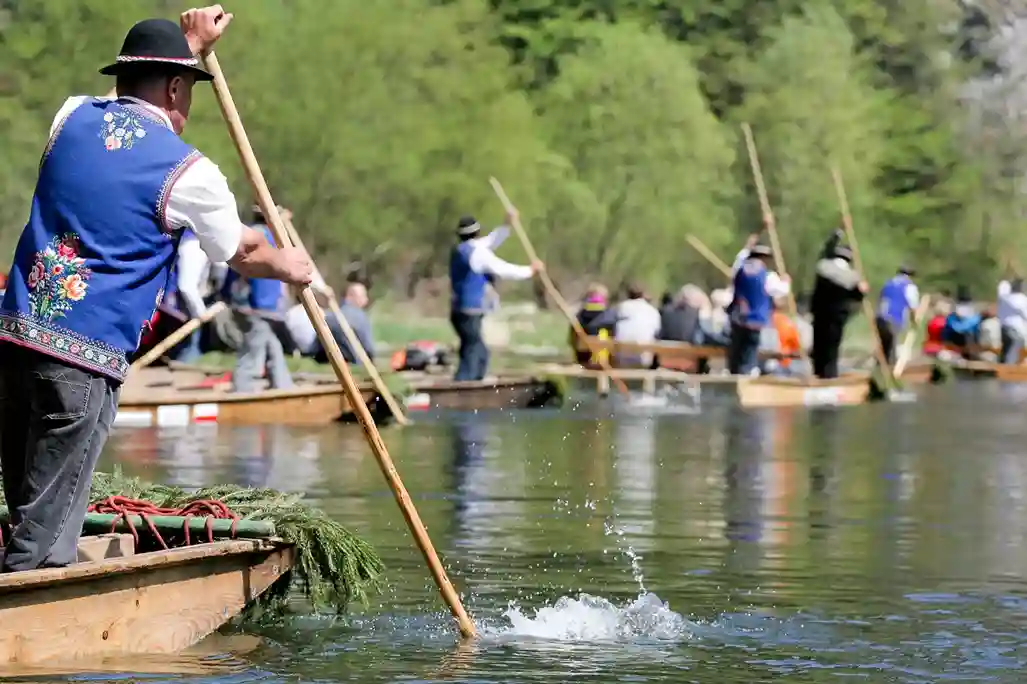
The raft carries 12 passengers + 2 raftsmen (one at the front, one at the back). The characteristic spruce twigs at the front are not decoration, but a natural barrier protecting passengers from splashing water.
5. They steer with 3-meter poles called "spryski"
The raftsman does not have an oar. He steers the raft using a 3-meter wooden pole called a "spryska" (or boat hook). This requires an immense feel for the river — especially in the rapids of the Gorge, where the raft gains speed and any mistake risks hitting a rock.
6. The raftsman's outfit is not a costume — it is a regional identifier
The blue (navy) jacket with a white shirt and a hat decorated with seashells — this is not a theatrical costume, but the authentic attire of the Pieniny highlanders, differing from the attire of the Podhale highlanders. The seashells on the hat come from old pilgrimages to Santiago de Compostela — a symbol of the road and journey that permeated the region.
Every element has cultural significance — the outfit emphasizes belonging to a specific village and raftsman generation.
7. The raftsman traditions are inscribed on the UNESCO heritage list
The raftsman traditions on the Dunajec were inscribed on the National List of Intangible Cultural Heritage of UNESCO in 2018. This is prestige on par with Krakow's Lajkonik, Silesian Barbórka, or falconry.
The inscription is not just an honor — it also provides legal protection and financial support for maintaining the tradition in its unchanged form.
8. The Polish Association of Pieniny Raftsmen has over 900 members
Founded in 1934, the Polish Association of Pieniny Raftsmen (PSFP) today has over 900 members, of which about 500 actively transport tourists. It is the largest professional organization of raftsmen in Europe.
9. The season begins on March 19, St. Joseph's Day
The patron saint of raftsmen is Saint Joseph. The rafting season traditionally begins on March 19 — his feast day. On this day, there is:
a solemn Holy Mass in the church in Sromowce,
a parade of raftsmen in ceremonial attire,
the first trip with a blessing before setting out.
The official tourist season runs from April 1 to October 31, excluding Easter Sunday and Corpus Christi.
10. The route we know today is not the original
Until 1976, the trip began at Zielone Skałki in Czorsztyn. After the construction of dams and the creation of Lake Czorsztyńskie, this place was flooded. The modern route starts only in Sromowce Wyżne-Kąty or Sromowce Niżne.
Routes:
to Szczawnica: 18 km, approx. 2 h 15 min,
to Krościenko: 23 km, approx. 2 h 45 min.
11. Over 340,000 people float down the Dunajec annually
This is a huge number — the Dunajec Gorge is the second most popular tourist attraction in the Polish mountains (after Krupówki). In the high summer season, several dozen trips take place daily, with rafts departing from the piers every few to a dozen minutes.
12. The legend of Bolesław the Brave, who cut through the Pieniny with a sword
This is one of the most commonly told stories by raftsmen. According to legend, there was once a great lake called Dunajec between the Tatras and the Pieniny. One day, King Bolesław the Brave, standing on the top of Gorce, saw a huge expanse of water and decided to help the local people by making fertile lands hidden under the water accessible.
He ordered his knights to crush the rocky banks so that the lake could drain away. This is how the Dunajec Gorge was supposedly created. Geology says otherwise (limestone rocks formed in the Jurassic and Cretaceous periods when the region was a sea floor), but the legend is more beautiful.
13. The second legend is Janosik — the Slovak Robin Hood
Raftsmen are happy to tell about the outlaw Janosik — a figure on the border of legend and history. Janosik (1688–1713) is a real Slovak outlaw, who according to tales, would take from the rich and give to the poor. He operated precisely in this region — in the Pieniny and Tatras.
The rock Sokolica visible during the trip is, according to legend, a place where Janosik used to hide from pursuit.
14. The first known person to float down the Dunajec recreationally was… a professor
According to tradition, a groundbreaking recreational trip was organized by Professor Józef Szalay of the Jagiellonian University in the first half of the 19th century. It was he who recognized the tourist potential of the Gorge and convinced spa guests from Szczawnica that it was a great attraction.
Without Szalay, Dunajec rafting might have ended with the cessation of timber transport in the 20th century.
15. What raftsmen do NOT do — contrary to what AI sites write
The internet is full of photos and descriptions in which raftsmen "sing regional songs and dance to traditional instruments on the raft." In reality, this does not happen — the raftsman has his hands full steering, and group singing occurs mainly in AI-generated descriptions and promotional clips.
What raftsmen actually do during the trip?
tell legends about the region (Trzy Korony, Sokolica, Diablica, ruins of Czorsztyn Castle),
joke with passengers — often with local, sometimes sharp humor,
point out landmarks in the area,
talk about birds visible over the river (herons, mallards),
answer questions — the most common is: "Can the raft tip over?".
(Spoiler: technically yes, in extreme conditions. Practically — no one remembers such a case on the tourist route for decades.)
The best time for Dunajec rafting? Not July at all
Most tourists choose a trip in July and August, but this is the worst time:
highest prices,
greatest crowds and queues at the pier,
strong sun — in the heat, a trip lasting almost 3 hours can be tiring.
Best times for Dunajec rafting:
🌸 May–June — high water level (faster trip), green Pieniny, fewer crowds, best temperature 🍁 September–October — subjectively the most beautiful time: colorful hills contrast with the white limestone rocks, low sun, perfect light for photos, almost empty
Dunajec River rafting with Trio Travel — stress-free, with transfer from Zakopane
From Zakopane to Sromowce Wyżne-Kąty it is about 75 km and an hour's drive one way. The logistics of independent travel include:
finding parking on site (paid, limited availability in season),
returning the car from Szczawnica or Krościenko to the car left in Sromowce,
keeping track of trip times (tickets are issued for specific times).
A day trip with Trio Travel solves all of this in one go:
✅ a bus picks you up from your hotel in Zakopane in the morning,
✅ takes you to the pier in Sromowce,
✅ we wait for you at the finish in Szczawnica/Krościenko — no more return problem,
✅ you return to your hotel in the evening,
✅ everything with a guide's care and AXA insurance.
You can choose:
Polish Dunajec rafting (classic, 8–9 hours including travel),
Slovak Dunajec rafting (shorter version from the Červený Kláštor side),
pontoon rafting — for those seeking a bigger adrenaline rush.
FAQ — Dunajec River rafting
Is Dunajec rafting safe? Yes. It is not white-water rafting — the rafts are stable, steered by two experienced raftsmen, and life jackets are included in the ticket price. The trip has been considered one of the safest attractions in the Polish mountains for decades.
Do I need to know how to swim? No. All passengers receive life jackets. The trip is also accessible to people who have never been in the water.
Can I take my phone and camera? Yes, but at your own risk. Although the raft is stable, water can splash — it's worth having a waterproof case or neck pouch.
What if it rains? The trip takes place in the rain (obviously except for storms). It's worth bringing a rain jacket. Sometimes rain adds atmosphere to the trip — the Pieniny in fog look almost mystical.
When can the trip be canceled? In case of very high water level (after heavy rains) or very low level (drought). In such cases, Trio Travel offers an alternative date or refund.
Where does the trip end? In Szczawnica (classic route) or Krościenko nad Dunajcem (longer version). Both towns are great places for lunch with a view of the Pieniny.
Muszynova
Book Dunajec River Rafting Online
Season runs from April 1 to October 31 — in July and August dates sell out 1-2 weeks in advance. Don't leave your reservation to the last minute.
TrioTravel Team
We live here, we know every corner
Latest posts
See all